

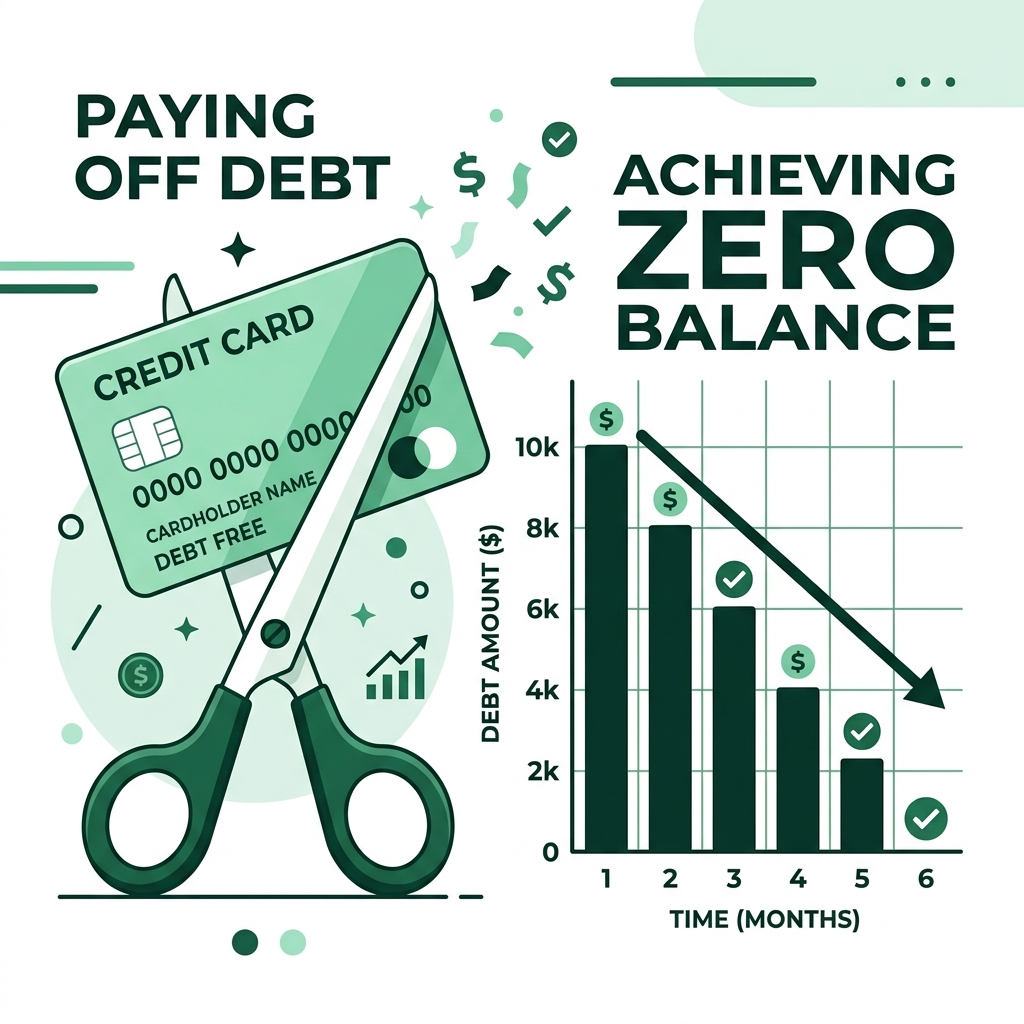
The Credit Card Debt Crisis and How to Escape It
The average consumer increasingly carries thousands in rolling credit card debt. This debt almost always carries brutal interest rates frequently eclipsing 20%. Making only the minimum required payments is exactly what the banking institutions desperately want you to do. By doing so, you essentially lock yourself into decades of prolonged stress and massive, completely avoidable profit for the bank. Understanding exactly how to strategically attack this balance is the first major critical step toward securing genuine financial freedom and lasting peace of mind.
When you carry a balance month to month, your purchases essentially cost you significantly more than the original checkout price. Every single day, compounding interest silently adds to your total owed amount. Breaking this toxic cycle requires intense discipline, a clear calculated mathematical strategy, and a firm commitment to immediately stop using the cards for any new purchases while you pay them down.
The True Cost of Minimum Payments — The Maths Are Brutal
Let us look at a genuinely stark mathematical example to clearly demonstrate exactly how the minimum payment trap fundamentally works.
- Starting Balance: $5,000
- Interest Rate: 22% APR
- Minimum Payment: 2% of the balance or $25 (whichever is higher, initially starting at roughly $100)
If you stubbornly refuse to pay anything more than the absolute bare minimum requested, the math becomes horrifying. At exactly $100 per month, the timeline stretches to over 30 years to fully clear the debt. Even worse, the total interest paid ultimately surpasses $8,500. You end up paying substantially more purely in interest charges than the entire original balance combined.
| Your Monthly Payment | Total Months to Pay Off | Total Interest Paid to Bank |
|---|---|---|
| Minimum only (Starts at $100) | 360+ Months | $8,500+ |
| $150 fixed monthly payment | 44 Months | $1,567 |
| $200 fixed monthly payment | 31 Months | $1,147 |
| $300 fixed monthly payment | 20 Months | $898 |
By simply increasing your rigid monthly payment from the $100 minimum to a strict $300, you violently slash the timeline down from 30+ years to a manageable 20 months. You also save over $7,500 in pure wasted interest.
Avalanche vs Snowball — Which Is Right for You?
There are two primary proven strategies for aggressively attacking multiple debts systematically.
The mathematical case for the Avalanche Method: With this strict strategy, you reliably pay the absolute mandatory minimum on absolutely every card, then hurl every single extra available dollar directly at the specific card sporting the objectively highest interest rate. For example, if you unfortunately have a massive $3,000 card at 24%, a $1,500 card at 19%, and an $800 card at 15%, you must aggressively pay down the 24% card completely first. This strategy mathematically saves you the absolute most money in total interest.
The psychological case for the Snowball Method: With this alternative strategy, you still pay the bare minimums everywhere, but you aggressively logically attack the smallest total balance card completely first, entirely ignoring the interest rates. Paying off the $800 card exceptionally quickly delivers a massive psychological win within just a few short months. Research prominently published squarely in the Harvard Business Review (2016) overwhelmingly demonstrated that this distinct method expertly creates exceptionally powerful momentum. Getting a quick definitive 'win' heavily uniquely motivates ordinary people to strongly successfully fiercely stick with the highly grueling repayment process successfully.
Verdict: If the exact interest rate variance firmly strictly between your active cards is genuinely mathematically less than 5%, the sheer intense emotional boost reliably delivered by the Snowball method usually yields the highest success rate for staying on track.
Balance Transfers — Read the Fine Print
How to Use a Balance Transfer Correctly
Strategically shifting your high-interest expensive balances onto a promotional 0% balance transfer card provides a vital pause from compounding interest, allowing 100% of your payment to hit the principal.
The Traps
Be intensely careful. These introductory periods end strictly on a specific date, and aggressively applying retroactive interest if the balance is not completely cleared in time is a common bank tactic. Additionally, always factor in the typical 3-5% initial transfer fee.
UK-Specific Strategies
Under Section 75 of the Consumer Credit Act, UK credit cards provide powerful legal protection for purchases between £100 and £30,000. While this is great for shopping, it does not alleviate the burden of compounding interest.
The Financial Conduct Authority (FCA) rules require lenders to actively assist customers trapped in persistent debt. If you are struggling, contacting your provider to request a frozen interest payment plan is a federally protected right.
Build the Emergency Fund Simultaneously
A crucial mistake many make is throwing every last penny at their debt while having absolutely zero cash reserves. If a £500 car repair hits, they are forced to securely rely on the credit card again, instantly reviving the vicious cycle.
We strongly recommend building a starter emergency fund of at least £1,000 (or ,000) absolutely first. Only then systematically launch your Snowball or Avalanche attack with absolute confidence.
Frequently Asked Questions
Should I pay off credit card debt or invest first?
Always rapidly pay off extremely high-interest expensive debt completely first. Very few safe long-term formal investments consistently successfully guarantee a massive 20%+ annual return.
Does paying off massive credit card debt quickly improve my credit score?
Yes. Lowering your credit utilization ratio dramatically is one of the fastest and most highly effective ways to quickly build an excellent credit score.
What is a debt-to-income ratio?
Your debt-to-income ratio compares your total monthly debt payments to your gross monthly income. Lenders use this to determine how well you manage debt.
Are balance transfers a good idea?
Yes, but only if you use the 0% introductory period strictly to pay down the principal balance without adding any new purchases to the card.
Final Thoughts
Make sure you fully grasp your financial choices by utilizing our free Salary Calculator.
Sources & Citations: Content verified against official guidelines from the IRS (US), HMRC (UK), and ATO (AU). Information is reviewed for accuracy prior to publication.
Try the Salary Calculator
Calculate your exact net salary after tax, NI, and deductions.
Open Calculator →
Comments are coming soon. Have feedback? Contact us.